
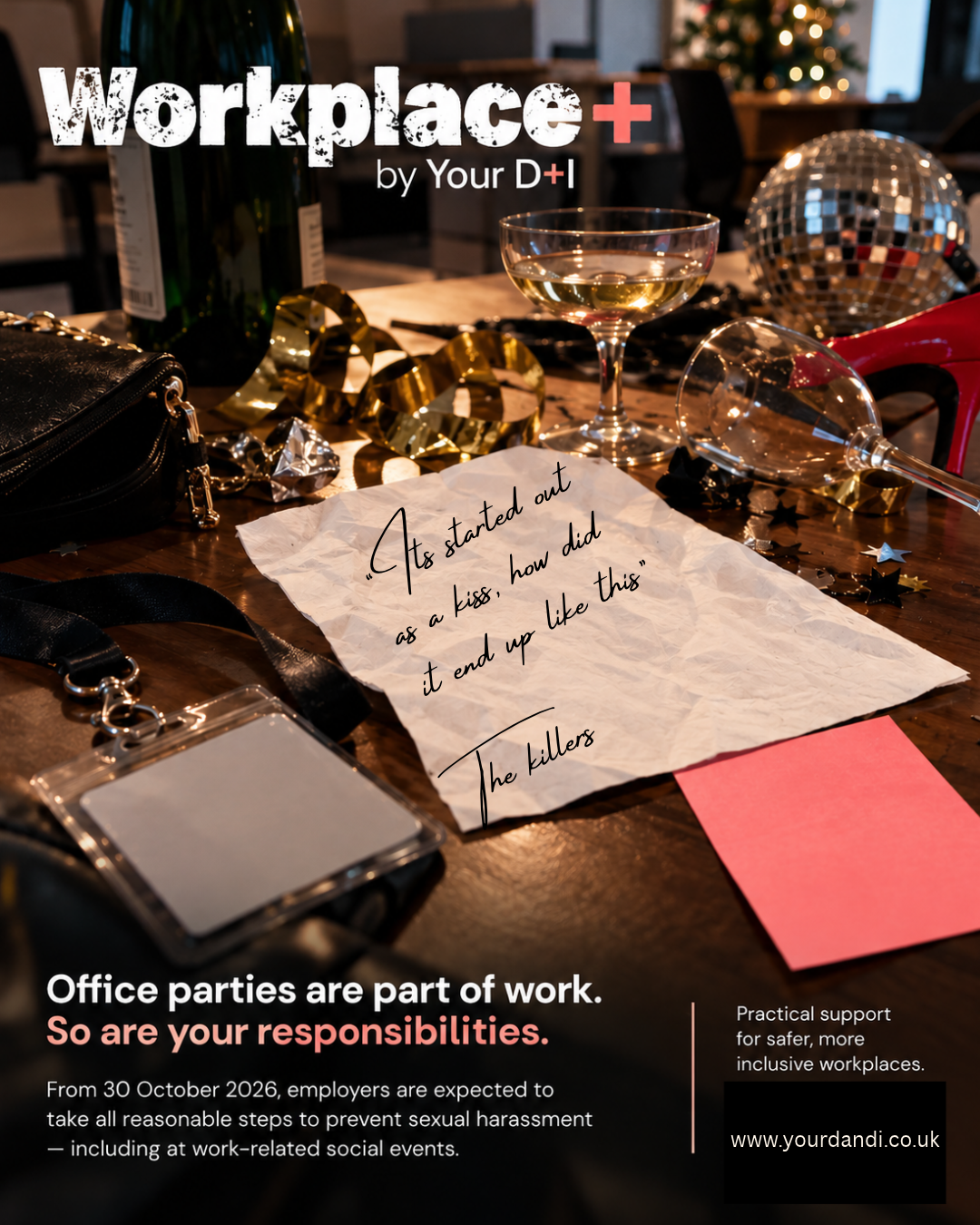
Office Christmas parties, sexual harassment and why 30 October 2026 should matter to every employer.
"It started out with a kiss..."
You know the song. Mr Brightside by The Killers.
It’s probably been played at every office Christmas party you’ve ever attended. Usually around the point when someone from finance decides they’re the lead singer and half the management team is dancing like nobody’s watching. And that’s what Christmas parties should be about.
Having a laugh, celebrating another year, spending time with colleagues and perhaps discovering that your normally very serious director has some questionable dance moves.
But what happens when the fun goes too far? And more importantly, what happens when your business hasn’t done enough to prevent it?
It was only a kiss. What's the big deal?
Picture this. It’s Friday, 11 December 2026. The company Christmas party is in full swing. The food’s been eaten, the drinks are flowing, and somebody has already requested Mr Brightside for the third time.
Sarah has worked for the business for nearly four years. She’s enjoying the evening, catching up with colleagues and having a dance. Later that night, a colleague who’s had a few too many drinks puts his arm around her and tries to kiss her.
She pulls away.
He tries again and manages to kiss her.
Sarah is visibly uncomfortable.
Someone nearby sees what happens and laughs.
“Oh, come on. He’s just drunk.”
Another colleague tells her not to make a big deal out of it.
“It was only a kiss.”
Sarah leaves shortly afterwards.
The following Monday, she emails HR.
Subject: Formal complaint about Friday night.
And suddenly, what some people dismissed as a bit of drunken fun has become a serious workplace issue.
This is a fictional scenario, but the circumstances are entirely plausible.
The Monday morning Oh Sh*t moment
HR starts investigating.
Sarah explains that this wasn’t the first time the colleague had behaved inappropriately. There had been comments about her appearance, sexual jokes and unwanted attention for months. She’d even mentioned some of it to her manager. But nothing really happened. The manager thought it was harmless banter.
Now the business is trying to establish what happened at the Christmas party, what people knew beforehand and why nobody acted. Someone asks when employees last received sexual harassment training. Someone else starts looking for the company’s harassment policy. And then comes the question. “What did we actually do to prevent this happening?”
There’s an uncomfortable silence. Because while the business has a policy, it hasn’t really considered the risks associated with workplace social events. Managers haven’t been given clear guidance. Nobody has reviewed whether previous concerns were being handled appropriately. And the organisation is struggling to demonstrate what preventative action it took.
Oh sh*t.
The Monday morning Oh Sh*t moment
From 30 October 2026, the Employment Rights Act 2025 strengthens the existing preventative duty under the Equality Act 2010.
Employers will be required to take all reasonable steps to prevent sexual harassment of their employees.
The previous duty, introduced in October 2024 through the Worker Protection Act 2023, required employers to take reasonable steps.
That additional word, all, matters.
It means employers need to consider all the preventative measures that are reasonable for their particular organisation, rather than simply selecting a few. And no, this doesn’t mean employers have to guarantee that sexual harassment will never happen.
It means taking a proactive approach to identifying risks, reducing them and making sure appropriate preventative measures are in place.
What is reasonable will depend on the business, including its size, operations and the risks employees face.
A small office-based business will have different considerations from a large hospitality organisation with hundreds of employees working late shifts and dealing with members of the public. But neither should assume that having a policy is enough.
Workplace+
Your Christmas party shouldn’t become your next Oh Sh*t moment.
Not sure whether you’ve taken all reasonable steps? Workplace+ helps you identify risks, equip your managers and take practical preventative action.

Does sexual harassment law apply to office Christmas parties?
Yes, work-related social events can fall within the scope of workplace discrimination and harassment law. Moving everyone from the office to a hotel function room doesn’t automatically remove an employer’s responsibilities. Neither does alcohol. Neither does it being outside normal working hours. And neither does someone saying they were only having a laugh.
Sexual harassment can include unwanted sexual comments, inappropriate touching, sexual advances and other unwanted conduct of a sexual nature that violates someone’s dignity or creates an intimidating, hostile, degrading, humiliating or offensive environment.
Of course, people can flirt at Christmas parties. Colleagues can form relationships. People can even kiss each other.
The issue isn’t kissing. It’s unwanted sexual behaviour. And there’s a pretty significant difference between two colleagues choosing to kiss and someone being kissed without their consent. We shouldn’t need a new law to understand that.
But businesses do need to understand their responsibilities when inappropriate behaviour occurs.
The excuses that could cost your business
I’ve spent years delivering workshops on inclusive language, workplace banter and inappropriate behaviour. And one of the biggest challenges is how easily poor behaviour gets dismissed.
“He didn’t mean anything by it.”
“She’s just being sensitive.”
“It was only a joke.”
“They’d both been drinking.”
“That’s just what he’s like.”
Sound familiar?
Now, I’m not against banter. I’ve built an entire workshop around the subject because I believe humour and laughter can be hugely important in creating positive workplace cultures. But banter isn’t a free pass to behave however you like. And alcohol isn’t an excuse for sexual harassment.
When managers repeatedly dismiss inappropriate behaviour, they’re not protecting workplace culture. They’re potentially creating an environment where people stop speaking up because they don’t believe anything will change. That’s when seemingly small problems can become much bigger ones.
What could sexual harassment cost an employer?
Let’s return to Sarah’s complaint.
Imagine the situation progresses to an employment tribunal. The business now faces the possibility of legal costs, management time spent preparing evidence, damaged working relationships and reputational consequences.
If Sarah successfully brings a sexual harassment claim and the tribunal finds that the employer breached its preventative duty, compensation could be increased by up to 25%. That uplift isn’t automatic, and the preventative duty itself does not create a standalone employment tribunal claim.
But the financial consequences can still be significant. And there’s another cost that doesn’t always appear on a spreadsheet.
The impact on the person who experienced the harassment. Someone who previously enjoyed their job may now dread going to work, lose confidence in their manager or decide to leave altogether. That matters just as much as the financial risk.
What about customers, clients and other third parties?
There’s another important change arriving on 30 October 2026.
Employers will also face an obligation not to permit harassment of employees by third parties where they have failed to take all reasonable steps to prevent it. That could include harassment involving customers, clients, contractors or other people employees encounter through their work.
Imagine your Christmas party includes clients. One of those clients repeatedly makes inappropriate comments to an employee. The employee reports it, but their manager doesn’t want to upset an important commercial relationship. So nothing happens.
Under the new provisions, the employer’s failure to take all reasonable steps to prevent third-party harassment could expose it to liability. And these protections aren’t limited to sexual harassment. They also extend to other forms of harassment covered by the relevant provisions of the Equality Act 2010.
It’s another reason businesses need to think beyond their own employees when assessing workplace risks.
Before you book the DJ, have you considered the risks?
I’m not suggesting we cancel Christmas parties. I’m not suggesting everyone should be limited to two drinks and a polite conversation about quarterly performance. And I certainly don’t want to see HR standing beside the dancefloor with a clipboard. But there are some things businesses should be thinking about before their Christmas celebrations begin.
Have you considered the risks associated with alcohol, the venue and the event itself? Do employees understand what behaviour is unacceptable? Are managers confident about challenging inappropriate conduct? Would someone know how to report an incident discreetly? And if something did happen, would your organisation respond appropriately?
These aren’t questions designed to ruin the fun. They’re questions that help make sure everyone can enjoy themselves without feeling unsafe or uncomfortable.
A great Christmas party is one where people can relax, have fun and go home with good memories. Not one where someone spends Monday morning writing a formal complaint.
Don't wait for your next Oh Sh*t moment
At Your D+I, we’ve been helping organisations create more inclusive workplaces for six years.
And one thing we’ve learned is that businesses often underestimate their risks until something goes wrong.
That’s why we developed Workplace+. It’s about giving organisations practical support to identify workplace risks, build manager confidence and address problems before they escalate.
Through workplace audits, workshops, practical resources and ongoing support, we help businesses move beyond policies that nobody reads and training that nobody remembers. Because preventing sexual harassment isn’t about becoming the workplace fun police. It’s about creating an environment where people understand boundaries, managers know how to respond and employees feel safe speaking up.
With the changes coming into force on 30 October, now is the time to review your approach. And with Christmas party season just around the corner, there’s a pretty good reason to start sooner rather than later.
Because “it was only a kiss” might sound like a harmless excuse to one person.
But it could be the beginning of a very serious problem for someone else.
And for the business that failed to take appropriate preventative action? That could be its next Oh Sh*t moment.
