
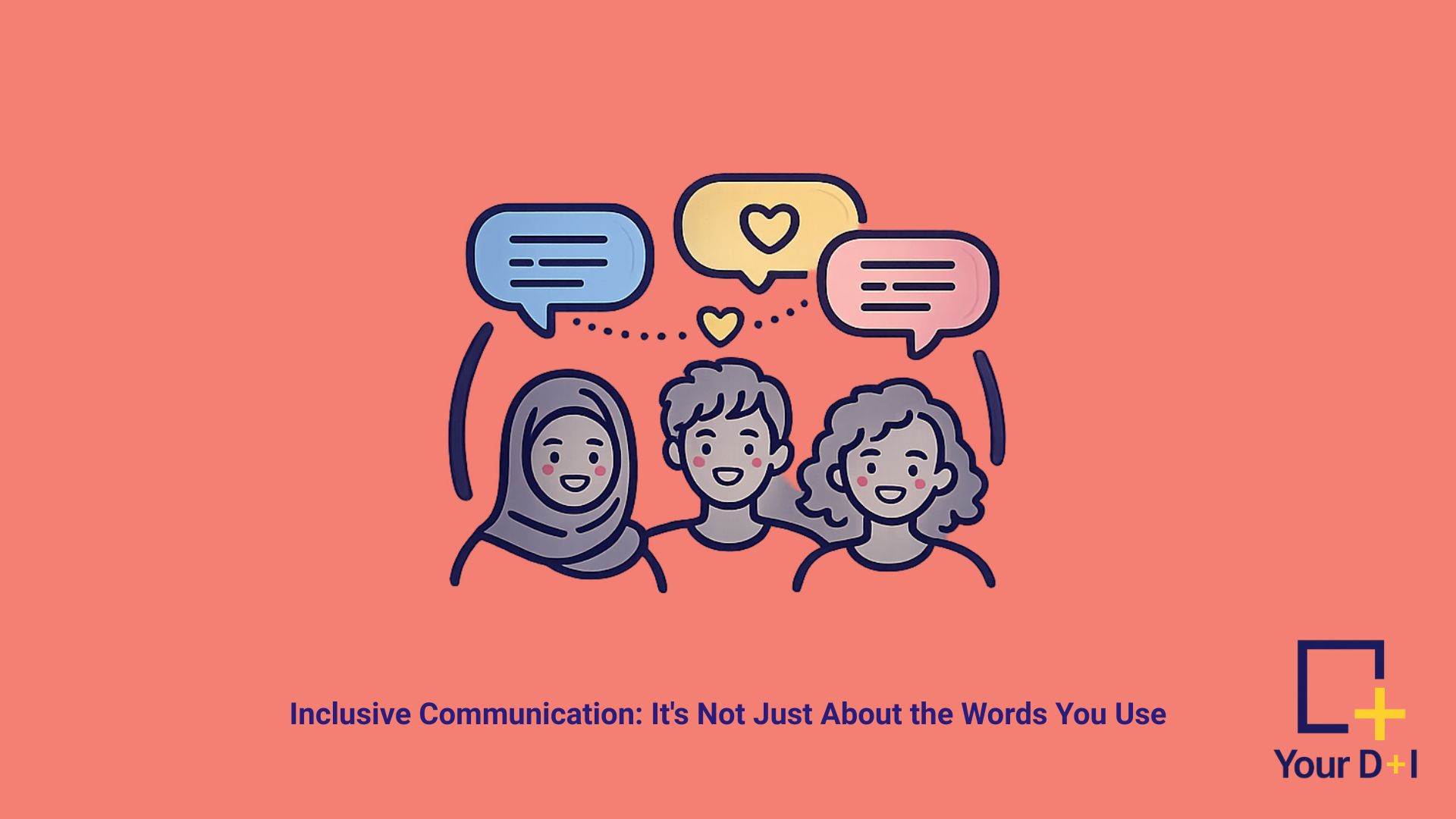
When organisations hear the phrase “inclusive language”, many immediately think about terminology.
- Pronouns.
- Protected characteristics.
- Political correctness.
- Saying the wrong thing.
But focusing solely on the words we use risks missing a much bigger question:
Can everyone actually access, understand and engage with our communication?
Because inclusion isn’t just about language. It’s about communication.
And for many organisations, communication remains one of the biggest barriers to creating an inclusive workplace.
The One-Size-Fits-All Problem
Think about how information is shared in your organisation.
Perhaps it’s:
- Long emails
- Company newsletters
- Team meetings
- PowerPoint presentations
- Intranet updates
- Policy documents
Now ask yourself:
Does everyone engage with these in the same way? The answer is almost certainly no.
Some employees prefer written communication. Others absorb information better through videos.
Some may benefit from voice notes or visual content.
Neurodivergent colleagues may process information differently. Employees with visual or hearing impairments may require accessible formats. Frontline workers may not even have regular access to email.
Yet many organisations continue to communicate as though everyone learns, processes and engages in exactly the same way.
Inclusion Starts with Access
You can have the best message in the world. But if people can’t access it, it has little value. Accessibility is often viewed as a specialist topic. The reality is much simpler.
Inclusive communication asks:
- Can everyone access this information?
- Can everyone understand it?
- Can everyone engage with it?
- Have we provided multiple ways to receive it?
This could mean:
- Captioning videos
- Using plain English
- Providing alternative formats
- Reducing unnecessary jargon
- Using visual content
- Offering voice recordings
- Making documents screen-reader compatible
- Ensuring frontline workers receive information in ways that work for them
None of these changes lower standards. They simply widen access.
Communication Is Never Neutral
Many of us assume communication is neutral.
We send an email. We publish a policy. We post an update on the intranet. Job done.
But communication is never neutral. Every communication choice sends a message about who we expect to engage with it.
- When we rely solely on lengthy emails, we assume everyone has the time, access and preference for reading them.
- When we communicate through videos without captions, we create barriers for some colleagues.
- When policies are full of legal jargon, we make it harder for people to understand their rights and responsibilities.
- When job adverts are packed with corporate buzzwords and industry terminology, we unintentionally narrow the audience who can see themselves in the role.
The question isn’t whether we’ve communicated. The question is whether people have been able to receive, understand and act on what we’ve communicated.
True inclusion requires us to move beyond simply delivering information and start thinking about how people experience it. Because communication only works when it works for the people receiving it.
The Recruitment Challenge
Inclusive communication also affects who joins your organisation.
Research has shown that language used within job advertisements can influence application rates and who feels encouraged to apply.
Words such as:
- Aggressive
- Competitive
- Dominant
- Rockstar
- Ninja
may unintentionally discourage some candidates.
Similarly, phrases such as:
- Native English speaker
- Young and energetic
- Digital native
can create barriers for otherwise highly qualified applicants.
The goal isn’t to remove personality. It’s to ensure the language focuses on skills, behaviours and outcomes rather than assumptions or stereotypes.
Internal Comms Matters Too
Many organisations spend significant time developing employee engagement strategies.
Yet employees often tell us:
- “I didn’t know about that.”
- “I never saw the email.”
- “I don’t understand what that means.”
- “We’ve heard this before.”
The challenge isn’t always the message.
Sometimes it’s the delivery.
If communication only works for people sitting at a desk, it isn’t inclusive.
If communication relies heavily on written content, it may not work for everyone.
If employees feel overwhelmed by information, they stop engaging altogether.
Communication inclusion means meeting people where they are.
The Business Benefits
Inclusive communication isn’t simply an EDI initiative.It’s a business performance issue.
When communication works:
- Employee engagement increases
- Understanding improves
- Miscommunication decreases
- Trust grows
- Recruitment pools widen
- Customers feel represented
- Workplace culture strengthens
Most importantly, people feel that they belong.
Questions Every Organisation Should Ask
Take five minutes and consider:
- Are we relying too heavily on email?
- Are our videos captioned?
- Could more visual content help?
- Are our documents accessible?
- Is our language clear and free from unnecessary jargon?
- Are we reaching frontline workers effectively?
- Are our recruitment materials attracting the widest possible talent pool?
- Do employees have multiple ways to engage with information?
If the answer to several of these questions is “I’m not sure”, there may be opportunities to improve.
Final Thought
Inclusive communication isn’t about getting every word perfect.
It’s about recognising that people communicate, learn and engage differently.
The organisations that thrive in the future won’t be those that simply communicate the loudest.They’ll be the ones that communicate in ways that everyone can access, understand and engage with.
Because inclusion starts long before someone speaks.It starts with whether people can hear, see and understand what you’re trying to say.
